 K-BOOTH
Hey Busan! How to Say Hi Like a Local

Photo: isaiahkim / Pixabay
If you land in Busan after spending time in Seoul, the very first thing you will notice is the rhythm of the streets. South Korea's vibrant southeastern harbor city has its own pulse, shaped by the sea breeze, steep coastal hills, and centuries of maritime culture. The local speech, known as Busan satoori (a prominent branch of the broader Gyeongsang dialect), sounds dramatically different from the smooth, even cadence of standard Seoul Korean. It has bounce, melodic pitch drops, and an unmistakably direct, affectionate warmth.
Most international visitors arrive equipped with standard phrases they learned from mobile apps or beginner textbooks. While those polite expressions will always be understood, using or even just recognizing real Busan greetings will instantly change how people react to you. Locals take immense pride in their dialect. When you greet someone with genuine Busan cadence, you immediately break the ice and trade formal distance for genuine seaside hospitality.
The Rhythm Behind the Words: Why Busan Sounds Different
Linguists classify standard Seoul Korean as a non-tonal language where stress and meaning rely heavily on syllable duration and grammatical particles. In contrast, Gyeongsang dialect retains pitch-accent characteristics from Middle Korean. That means Busan speech moves up and down like a wave: questions often dive down sharply at the end, while statements carry punchy, rhythmic accents. To ears unfamiliar with the dialect, conversations between friends can sometimes sound like an intense debate, but in reality, that sharp tone is simply enthusiasm and familiarity.
Do not mistake Busan loudness for anger. In coastal culture, raising your voice slightly and speaking with energetic punch was historically necessary to be heard over ocean winds and bustling markets. It conveys openness, not irritation.
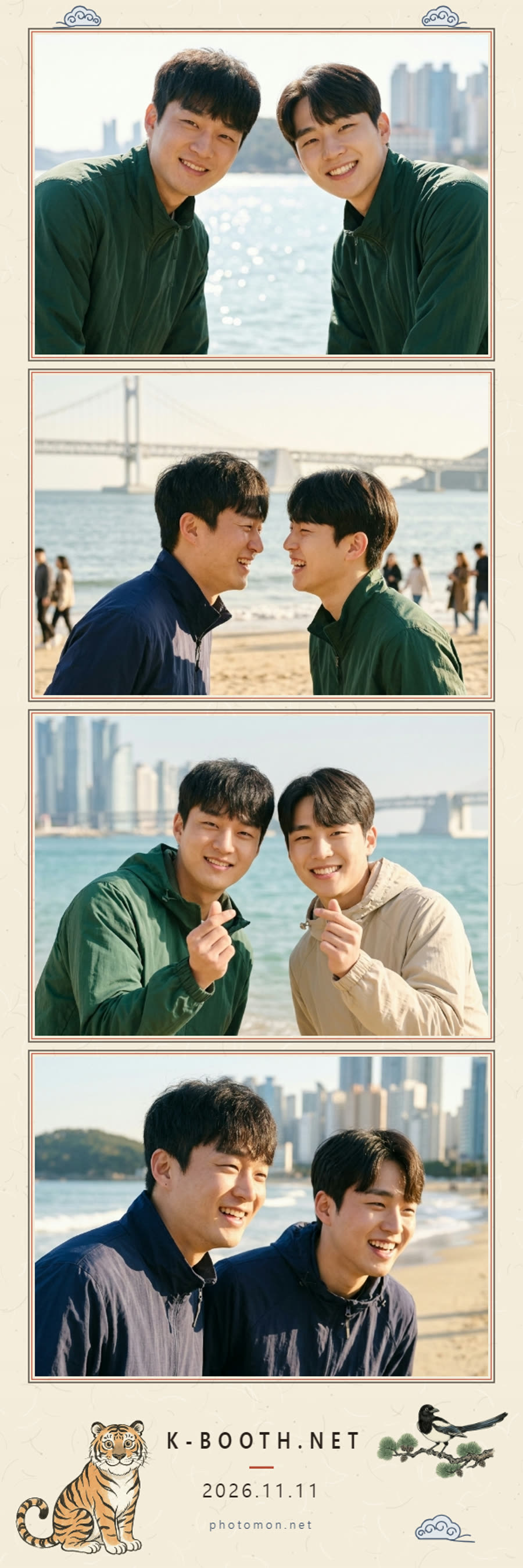 Take a 4-cut like this with your friends →
The Ultimate Local Opener: Food First
In standard Korean, asking if someone has eaten is a standard polite inquiry, but in Busan, it serves as the ultimate casual "hello" between acquaintances and friends. You will hear this phrase tossed around subway exits, university campuses, and neighborhood alleys at almost any hour.
"밥 뭇나?" (Bap munna?) — Did you eat?
In standard Korean, this phrase is "밥 먹었어?" (Bap meogeosseo?). In Busan, the verb for eating shifts to "묵다" (mukda), yielding the swift, bouncy contraction "뭇나?" (munna?). When friends bump into each other around noon or dinner time, they rarely start with a formal greeting. Instead, they drop right into this question with a rising intonation on the first syllable that drops quickly on the second. It shows practical care: asking about your meal is the quickest way to show someone that you care about their well-being.
Running Into Friends: Street Encounters and Casual Reactions
When you are meeting peers or close buddies around vibrant youth hubs like Seomyeon, Gwangalli Beach, or PNU (Pusan National University), you will want short, energetic greetings that sound natural in passing.
- "왔나?" (Watna?) — You made it? / You're here?: This is the quintessential casual greeting when meeting up with a friend. Instead of saying hi, a Busan native looks up, smiles, and delivers this one-word greeting with a punchy tone. It acknowledges your arrival immediately and sets an effortless, relaxed vibe.
- "어데 가노?" (Eode gano?) — Where are you going?: If you happen to bump into an acquaintance on the sidewalk or waiting at a bus stop, you use this phrase. In standard speech, it would be "어디 가?" (Eodi ga?). The Busan version substitutes "어데" (eode) for where and pairs it with the characteristic dialect question ending "-노" (-no).
- "맞나?" (Matna?) — Really? / Is that so?: While not an opening hello, this is the single most vital conversational reaction word in Busan. In Seoul, people say "진짜?" (Jinjja?) or "정말?" (Jeongmal?). In Busan, everyone punctuates their greetings and catch-ups with a surprised, affirming "맞나!". Drop this into a conversation while listening to someone share their day, and you will sound like a seasoned local.
Market Salutations and Neighborhood Hospitality
Busan's cultural heartbeat thrives in traditional trading spaces like Jagalchi Market, Gukje Market, and Bupyeong Kkangtong Market. Here, generations of vendors, particularly the iconic "Jagalchi ajumma" (female merchants), have developed welcoming slogans that have become cultural symbols of the city.
"오이소, 보이소, 사이소!" (Oiso, boiso, saiso!) — Come, look, and buy!
You will spot this famous phrase painted on banners, stamped on archways, and shouted along the seafood stalls. It represents polite imperative endings in the Gyeongsang dialect. Standard Korean would say "오세요, 보세요, 사세요" (oseyo, boseyo, saseyo), but the local "-이소" (-iso) ending adds a snappy, hospitable rhythm. Vendors call this out to invite passersby to step closer and browse fresh catches without pressure.
When addressing friendly stall owners or restaurant staff, locals often add regional polite markers rather than sticking strictly to standard honorifics. Ending your polite requests with the soft regional marker "-예" (-ye) instead of standard "-요" (-yo) shows that you are tuning your ear to the neighborhood environment.
Warm Farewells: Parting with Busan Character
How you leave a conversation in Busan is just as meaningful as how you start it. Local farewells emphasize protection, gratitude, and mutual reassurance rather than simple formulas.
- "단디 해라" (Dandi haera) — Take good care / Watch your step: The word "단디" (dandi) means properly, carefully, or tightly. Older relatives, hostel hosts, or close friends often say this as you step outside into bad weather or head out on a long hike along the coastal cliffs. It translates roughly to "Stay safe and keep your wits about you."
- "고맙심더" (Gomapsimdeo) — Thank you kindly: While the standard formal "감사합니다" (gamsahamnida) is universally used, older Busan locals frequently express gratitude with this warm dialect version. Saying it with a bright head nod as you finish your bowl of pork soup (dwaeji gukbap) will earn you radiant smiles from the kitchen crew.
Always keep age and familiarity in mind. Phrases like "왔나?" (Watna?) and "밥 뭇나?" (Bap munna?) belong strictly to casual speech (banmal). Use them with friends your own age or younger. When speaking to older vendors, stick to polite phrasing or soften your words with respectful smiles and nods.
Take a 4-cut photo with your friends here, wherever they are.